Search for a Udemy alternative and you get lists of ten platforms with their prices. They answer "where should I go?" For most instructors, that is the wrong question. Udemy is very good at one thing: putting your course in front of strangers. It is much weaker at the thing that pays over years, which is selling your next course to people who liked the last one.
So instead of leaving, many instructors split the job. The first course stays on Udemy, where people find it. The second course, the deeper one, lives on their own site, where they can talk to their students.
We make LearnHouse, one of the places a second course can live, so this piece is not neutral. We have tried to be fair about when this plan doesn't make sense.
Why the second course is different
Your first course has one job: be found. A marketplace is built for that. Your second course has a different job: be bought by people who finished the first one and want more. That depends on being able to reach them, and on Udemy, reaching them has rules.
According to Udemy's help center, you can send two promotional announcements per course per month, and they can only point to your Udemy courses. You can send four educational announcements per course per month, and their links must go to free, non-promotional content that doesn't ask for contact details. Students who bought on Udemy keep access to your course there, even if you unpublish it.
Those rules protect learners from spam, and they are fair to Udemy, which found those buyers. But they also mean every student you win on Udemy stays a Udemy customer. Your second course, if it is on Udemy too, has to be found again, in a marketplace where Udemy said in 2025 it was "intentionally reducing transactional course sales in favor of recurring subscription revenue". We looked at what that shift means for instructor pay in what the SEC filings show about Udemy instructors.
The two courses side by side
| First course, on Udemy | Second course, on your own academy | |
|---|---|---|
| Who finds it | Udemy's marketplace and search | You: your newsletter, channel, social accounts and past students |
| Who sets the price | You set a list price; Udemy runs site-wide sales | You, including your own discounts |
| What you keep | 37% of a marketplace sale, 97% through your own link, a share of a 15% pool for subscription viewing | The full price, minus your payment provider's fee |
| Can you tell buyers about your next course? | Through Udemy, about Udemy courses | Yes, they are your students |
| What else you can offer | The course | Programs, certificates, a community, live classes |
The Udemy figures are from Udemy's revenue share page and its 2023 instructor letter.
An example: a guitar teacher
Sam teaches guitar and has a YouTube channel with a modest following.
On Udemy: "Guitar for complete beginners", 3 hours, first chords and strumming. Strangers find it in search. Some leave reviews, some subscribe to Sam's channel because the course mentions it in the intro.
On Sam's own academy: "Play your first 20 songs", a 10-week program. One lesson unlocks each week so students practise before moving on. There is a monthly live Q&A, a space where students post recordings for feedback, and a certificate at the end.
Sam announces the program on YouTube and to a small newsletter. Everyone who joins becomes a student of Sam's academy, so when Sam records a fingerpicking course a year later, the first people to hear about it are the ones who finished the songs program.
Nothing in Udemy's rules stops this, because the people who join come from Sam's own channel, not from Udemy messages.
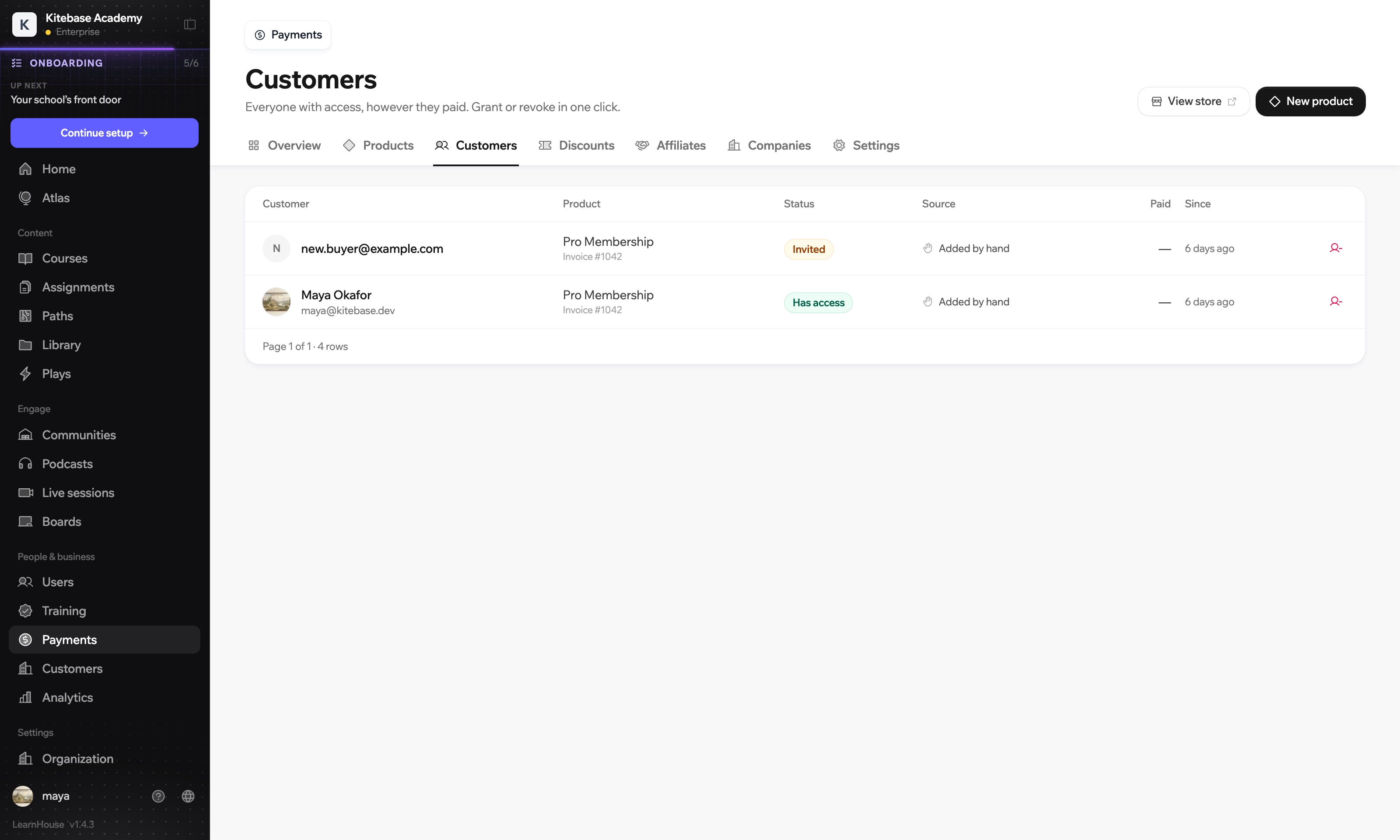
What the second course can include on LearnHouse
If you build that second course on LearnHouse, these are the pieces from the example:
- Drip content to unlock one lesson a week
- Learning paths to group several courses into one program, with a certificate anyone can verify
- A community where students share work and ask questions
- Live sessions with recordings, for a monthly Q&A
- The built-in newsletter to write to everyone who took a course
- Payments straight to your own Stripe account, with discount codes. LearnHouse takes 0%; Stripe charges its card fee.
- The iOS and Android app, so students can follow along on their phone
Payments, drip content, communities and the app are on every hosted plan. Paths and certificates start on Pro, and live sessions on Business. The pricing page lists each plan.
Does it pay for itself?
LearnHouse starts at $47 a month billed yearly, so $564 a year, with a 14-day free trial.
Here is an illustrative example, not a forecast. Say your second course sells for $100. As a Udemy marketplace sale it would pay you $37. On your own academy it pays $100 minus Stripe's fee. The difference covers the yearly plan after roughly ten sales. If you expect fewer than that from your own audience in a year, wait until your channel is bigger.
When to keep everything on Udemy
This plan is not for everyone. Keep both courses on Udemy if:
- you have no channel of your own and don't want to build one
- you don't want to do any marketing at all
- most of your income comes from subscription viewing and marketplace search, and it works for you
In those cases the marketplace is doing work you would otherwise have to do yourself.
How to start
- Leave your Udemy courses as they are.
- Pick the course you would most like to make deeper. That is your second course.
- Build it from your original files. The Udemy migration page walks through it.
- Tell your own audience. Don't use Udemy messages to send students to it.
- Give it three months before you judge it.
The LearnHouse vs Udemy comparison has the full feature and price breakdown if you want it.
Frequently asked questions
Is LearnHouse a Udemy alternative?
It can be, but it is not a marketplace. Udemy brings buyers to your course. LearnHouse gives you your own academy, and you bring the buyers. Many instructors use both.
Can I tell my Udemy students about a course on my own site?
Not through Udemy messages. Udemy's rules allow promotional announcements only for your Udemy courses, and educational announcements can only link to free, non-promotional content. Reach people through your own channels instead.
Does LearnHouse take a cut of my sales?
No. Payments go to your own Stripe account and LearnHouse takes 0%. Stripe's card fee applies.
Do I need to remove my course from Udemy?
No. Students who bought it keep access either way, and your first course can keep bringing in new people. Check your Udemy instructor terms before selling the exact same course elsewhere at a different price.
Is the free open source version enough to sell courses?
The free community edition is for running LearnHouse on your own server. Selling courses on a self-hosted install needs the paid Enterprise Edition. On the hosted plans, payments are included from the first plan.