There is no single best open source LMS. Moodle is the safe choice for schools that want every feature and a huge community. Open edX is built for large public courses. Canvas LMS is mainly sold as a hosted service, though the code is open. Chamilo and ILIAS are long-running PHP projects with their own communities. LearnHouse is the newest of the six and the easiest to install, with fewer institutional features in its free edition.
A note before the details: LearnHouse publishes this blog, and LearnHouse is one of the six platforms below. We applied the same criteria to all of them, compared from each project's public documentation and repositories on 13 November 2026, and we say where another platform is the better pick.
How the six compare
| Moodle | Open edX | Canvas LMS | Chamilo | ILIAS | LearnHouse | |
|---|---|---|---|---|---|---|
| Licence | GPL-3.0 or later | AGPL-3.0 | AGPL-3.0 | GPL-3.0 or later | GPL-3.0 | AGPL-3.0 |
| Main language | PHP | Python, JavaScript | Ruby, JavaScript | PHP | PHP | TypeScript, Python |
| Recommended install | LAMP stack | Tutor (Docker) | Manual, Apache and Passenger | Web installer | Manual | CLI and Docker |
| Database | PostgreSQL, MySQL or MariaDB | MySQL and MongoDB | PostgreSQL | MariaDB or MySQL | Not stated in README | PostgreSQL |
| Vendor-hosted option | MoodleCloud | Service providers | Instructure | Service providers | Service providers | LearnHouse Cloud |
Licences and stacks are taken from each project's repository or documentation, checked on 2026-11-13.
Moodle
Moodle is released under the GNU GPL version 3 or later. It is developed mainly on Linux with Apache, PHP and PostgreSQL, MySQL or MariaDB. The documentation gives modest hardware minimums: 512MB of memory (1GB or more recommended), a 1 GHz processor, and about 5GB of disk as "a realistic minimum" once you add content.
Those requirements are the lowest of the six, and almost any host that supports PHP can run it. In our view the cost is the interface, which takes training, and the upkeep that comes with a large, configurable application.
If you would rather not run it yourself, Moodle sells MoodleCloud. Plans are billed yearly in Australian dollars: Starter at $230 AUD for 50 users, Mini at $380 AUD for 100, Small at $700 AUD for 200, Medium at $1,700 AUD for 500 and Standard at $3,000 AUD for 750 users. There is a 28-day free trial.
Choose it when you need depth and a long track record. We keep a longer LearnHouse and Moodle comparison if you are deciding between the two.
Open edX
Open edX is licensed under AGPL-3.0. It is written in Python on Django, with React micro-frontends. The project's own README recommends two routes to production: a service provider, or Tutor, which it describes as the community-supported, Docker-based distribution. A bare-metal install is possible, but the README calls it "mostly undocumented". That install needs MySQL 8.0, MongoDB 7.x and Memcached.
The product page lists an authoring studio, content libraries, open response assessment, LTI 1.3 integrations, extension blocks called XBlocks and an analytics dashboard called Aspects.
The project describes the LMS as built for large-scale enrolment. With two databases and several services, it is heavy for a small school or a single creator, and you will want someone who is comfortable with Docker and Python. Our Open edX comparison goes further.
Canvas LMS
Canvas is published by Instructure under AGPL-3.0. Instructure sells it as a hosted service and does not publish institutional pricing. Individual teachers can open a free Canvas account with modules, SpeedGrader, rubrics, discussions and the mobile apps.
Running the open source version yourself is a bigger job than the PHP projects here. The production guide asks for Ruby 3.4.1 or newer, Node.js 20, PostgreSQL 14 or newer, Redis 6 or newer, Apache with Passenger, and recommends at least 8GB of RAM. The rich content editor also needs a separate API service.
Choose Canvas when your staff and students already use it elsewhere and you have the people to operate a Rails application. See LearnHouse and Canvas LMS for a side-by-side view.
Chamilo
Chamilo is a fork of Dokeos, launched in January 2010 and distributed under GPL-3.0 or later. Its members voted in 2025 for BeezNest, the company that has been its main developer for over 15 years, to lead the project officially.
The current README targets PHP 8.3, 8.4 or 8.5 with MariaDB 10 or higher (MySQL 5.7 or higher also works) on Apache. You unpack a release, create a database and finish in a web installer. Third-party installers such as Softaculous and Installatron carry it too, which makes it one of the few LMSs you can put on ordinary shared hosting.
Chamilo's project page lists wikis, group workspaces, gradable forums, an internal social network, attendance tracking and online assessment tools. It suits organisations that want a lighter PHP LMS than Moodle and do not need the larger ecosystem.
ILIAS
ILIAS has been in development since 1998 and is published under GPL 3.0. It is run by a society, ILIAS open source e-Learning e.V., based in Cologne. The society lists 17 service providers and more than 90 institutional members.
Its feature list includes course management, learning modules, tests and assessments, portfolios, surveys, wikis and blogs. On standards it lists SCORM 1.2 and SCORM 2004 learning modules, IMS QTI for tests, IMS LTI for external applications and LOM metadata.
The society and its service providers are the reason to choose ILIAS: you can join, pay for support from a listed provider and have a say in development. Check how much of the documentation you need is available in your language before you commit.
LearnHouse
LearnHouse is licensed under AGPL-3.0 and installs with one command, npx learnhouse@latest setup, which writes a Docker Compose file with PostgreSQL and Redis included. The self-hosting docs put the minimum at 1 core and 2GB of RAM.
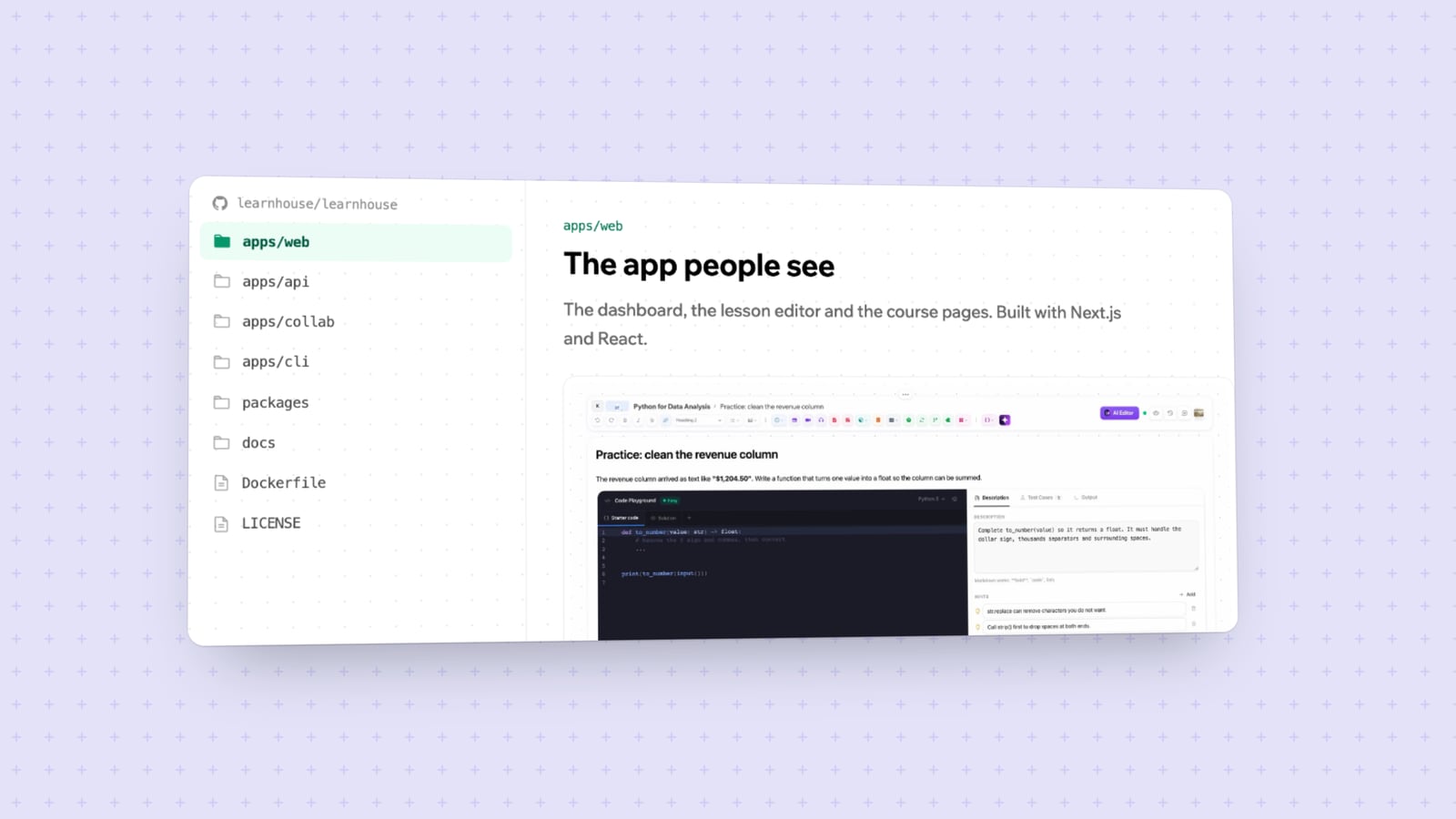
The free edition covers courses with a block editor, assignments and grading, communities, podcasts and AI features that use your own provider key. We think the interface is its strongest point. You should judge that yourself from the screenshots on the design page.
Now the weaknesses, judged by the same criteria as the others:
- It is the youngest project here. The first commit was in May 2022, so it has far less history than Moodle or ILIAS and no third-party plugin ecosystem to speak of.
- Several things institutions expect are outside the free edition. Payments, SSO, SCORM, LTI, audit logs and live sessions need the paid Enterprise Edition licence or LearnHouse Cloud.
- There is no official Helm chart. The images run on Kubernetes, but you write the manifests.
If you need SCORM packages and LTI tools for free on your own server today, Moodle or ILIAS is the better choice. The open source page explains what is in each edition.
How to choose
Start with who will run it. A PHP LMS (Moodle, Chamilo, ILIAS) fits a team that already manages PHP hosting. Open edX and Canvas need people who are comfortable with heavier stacks. LearnHouse and Open edX with Tutor both lean on Docker.
Then look at what you teach. Traditional courses with tests and gradebooks point to Moodle, Canvas or ILIAS. Large open courses point to Open edX. Creators and companies that also want a community and a storefront in the same product will find that closer to what LearnHouse and the commercial course platforms do. We compare those in Teachable vs Thinkific vs Kajabi vs Podia.
Finally, check the licence against your plans. GPL and AGPL both let you use the software commercially. AGPL adds one obligation that matters for hosted software: if you modify the code and offer it to users over a network, you must share your changes under the same licence. Three of the six platforms here use it.
If you are still deciding whether to host at all, read self-hosted vs cloud LMS next.
Frequently asked questions
Is Moodle really free?
Yes. The software is free under the GPL. You pay for the server and the time to run it, or for a hosted plan such as MoodleCloud, which starts at $230 AUD a year for 50 users.
Which open source LMS is easiest to install?
Chamilo and Moodle install on a standard PHP host, and Chamilo is offered by one-click installers. LearnHouse and Open edX (through Tutor) install with Docker. Canvas LMS has the longest manual setup of the six.
Can I sell courses with an open source LMS?
It depends on the platform. MoodleCloud lists Stripe course sales from its Small plan upward. In LearnHouse, payments are part of the Enterprise Edition and LearnHouse Cloud. For the others, check their documentation for the payment options they support.
Is Canvas open source?
The Canvas LMS code is on GitHub under AGPL-3.0. Instructure also sells it as a hosted commercial service.
Does AGPL stop me from using the software commercially?
No. You can use AGPL software for commercial work. If you change the code and run it for other people, you have to publish your changes under the same licence.