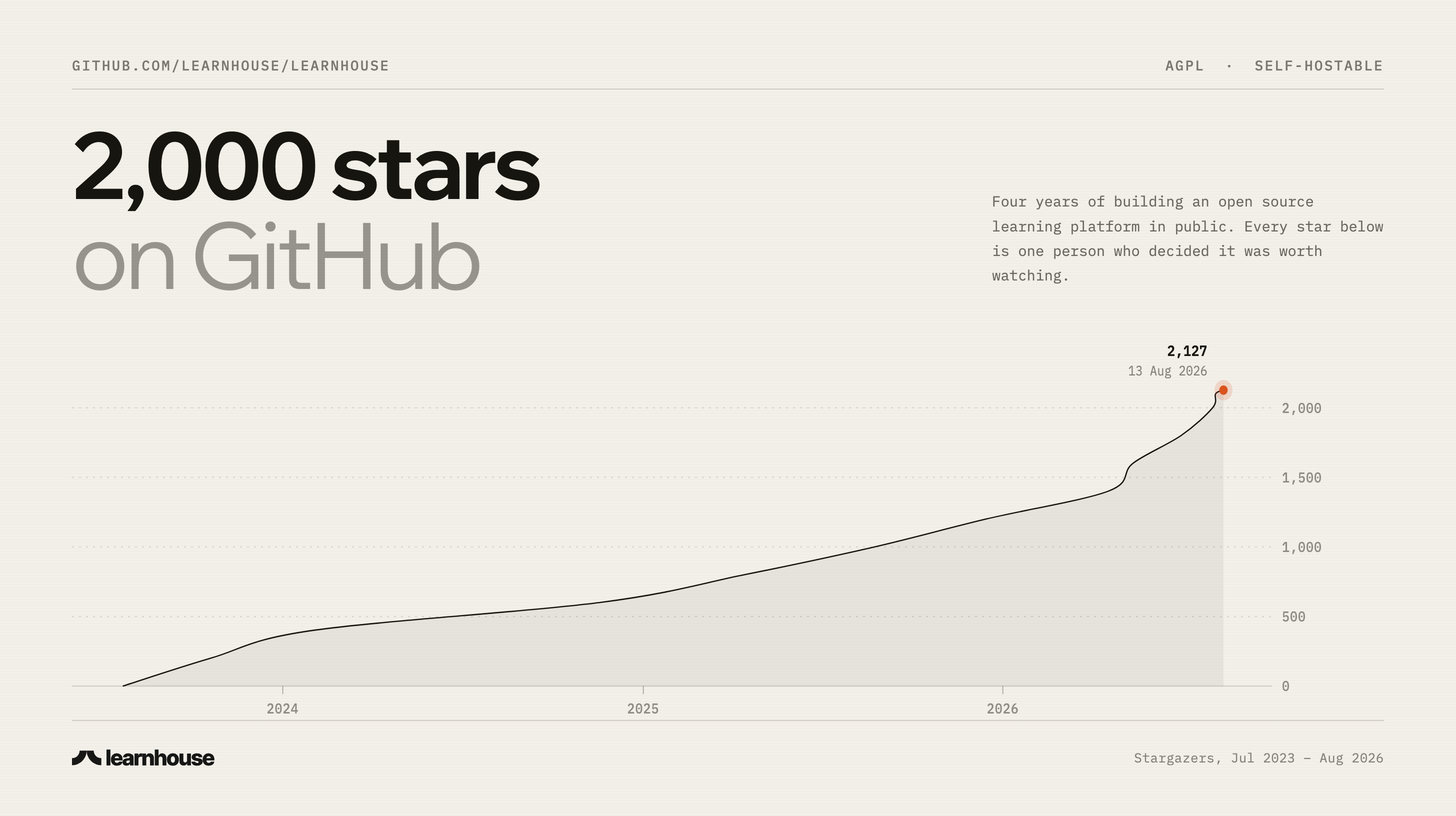
Welcome to LearnHouse
An introduction to the LearnHouse project, what I'm building, and why I'm starting a blog to share the journey.
Hi, and welcome. If you're reading this, you've found your way to the very first post on the LearnHouse blog. It feels like a good moment to say hello and explain what this project actually is.
What is LearnHouse?
LearnHouse is an open source learning platform. I'm building it for creators, schools, universities, communities, agencies, and businesses who want a modern way to teach online without being locked into a closed system.
Most teaching tools today fall into two camps. Closed platforms that own your audience, take a cut of every sale, and keep your content behind their brand. Or open source projects that technically do the job but feel like they were built in 2012 and haven't moved since. I'm trying to sit in the space in between: genuinely open, genuinely modern, and built to grow with whoever is using it.
Everything you need in one place
I didn't want to build yet another narrow course platform. LearnHouse is designed so that everything you need to teach online is already in the box. Courses, payments, communities, AI, podcasts, collaborative boards, code playgrounds, analytics, all under one roof.
That means no stitching together five different SaaS tools just to run a program. No separate community platform, no separate checkout, no separate assistant, no separate forum. You're not paying for a dozen subscriptions and praying the integrations hold. It's all one product, built to work together from the start.
Headless, API-first, and automatable
Everything you can do in the LearnHouse interface, you can do with the API. The whole platform is API-first, which means the UI you see is just one client talking to a full REST API. Every resource is exposed: organizations, courses, chapters, activities, users, enrollments, payments, communities, and more.
That opens up a few things that traditional LMSs make painful:
- Run it headless. Use LearnHouse as the content and learning backend, and build your own frontend on top. Embed courses inside your existing app, ship a custom mobile experience, or plug the learning layer into a product you already have.
- Automate the boring parts. Provision new users from your HRIS, auto-enroll teams into onboarding when they join Slack, sync course completions to your CRM, or kick off certificates when someone hits 100% on a track. If a system can make an HTTP call, it can drive LearnHouse.
- Connect your stack. Native integrations with tools like Zapier, Stripe, and Slack cover the common workflows, and the REST API covers everything else. Webhooks and API tokens let you wire LearnHouse into CI/CD pipelines, internal tools, or any SaaS in your stack.
- Use the CLI. A command-line tool for spinning up instances, managing configuration, and running maintenance tasks, so ops work stays scriptable and version-controllable.
- Build on top of it. Agencies can ship entirely custom learning products for their clients without rewriting the backend. Teams can extend the core with their own plugins and flows. The whole codebase is open, so if something doesn't exist yet, you can add it.
Built to be yours
Under the hood, LearnHouse is AGPLv3 licensed and designed to be self-hosted. You can run it on your own infrastructure, bring your own domain, white-label the whole thing, and keep full control of your data. Or you can let me host it for you on the cloud version and skip the setup.
I also mean "yours" in the literal sense: your content and your data belong to you, not to us. You can export your courses, users, enrollments, and community data whenever you want, in open formats. If you ever decide LearnHouse isn't the right fit, you can take everything with you and walk. There's no lock-in, no hostage situation, no "enterprise plan to unlock your own data." Since the platform is open source, you can always inspect exactly how your information is stored and moved.
It's also multilingual from day one, with the platform interface available in 19 languages.
The same codebase powers everything: a solo creator selling their first course, a university running an entire program, a company onboarding new hires, and an agency building learning products for their clients. That's the bet I'm making, that one well-designed platform can serve all of those cases better than a dozen narrower ones.
Who's behind it
That's me. I'm Badr, but most people online know me as sweave. I'm a cloud and software engineer, and I like building things. LearnHouse is the project that most of my work pours into right now.
I started LearnHouse because every tool I looked at felt like a compromise. The closed platforms were slick but rented. The open source ones were solid, but their interfaces felt like a different era of the web. I wanted something open, modern, and without a tax on every sale, so I built it.
I also just really enjoy designing nice, clean things. A lot of LearnHouse exists because I wanted an excuse to keep doing that.
Why a blog?
I already have docs for how things work and marketing pages for the pitch. What I didn't have was a place for everything else.
This blog is that place. Expect:
- Product stories. The reasoning behind the features I ship, not just the release notes.
- Teaching ideas. Things I've learned from creators using LearnHouse to teach real students.
- Engineering notes. Short, honest posts about the parts of the stack I find interesting.
No fixed schedule. I'll post when I have something worth saying.
Come along
If any of this sounds interesting, the best ways to follow along are GitHub, Discord, and this blog. Thanks for being here, and see you in the next one.