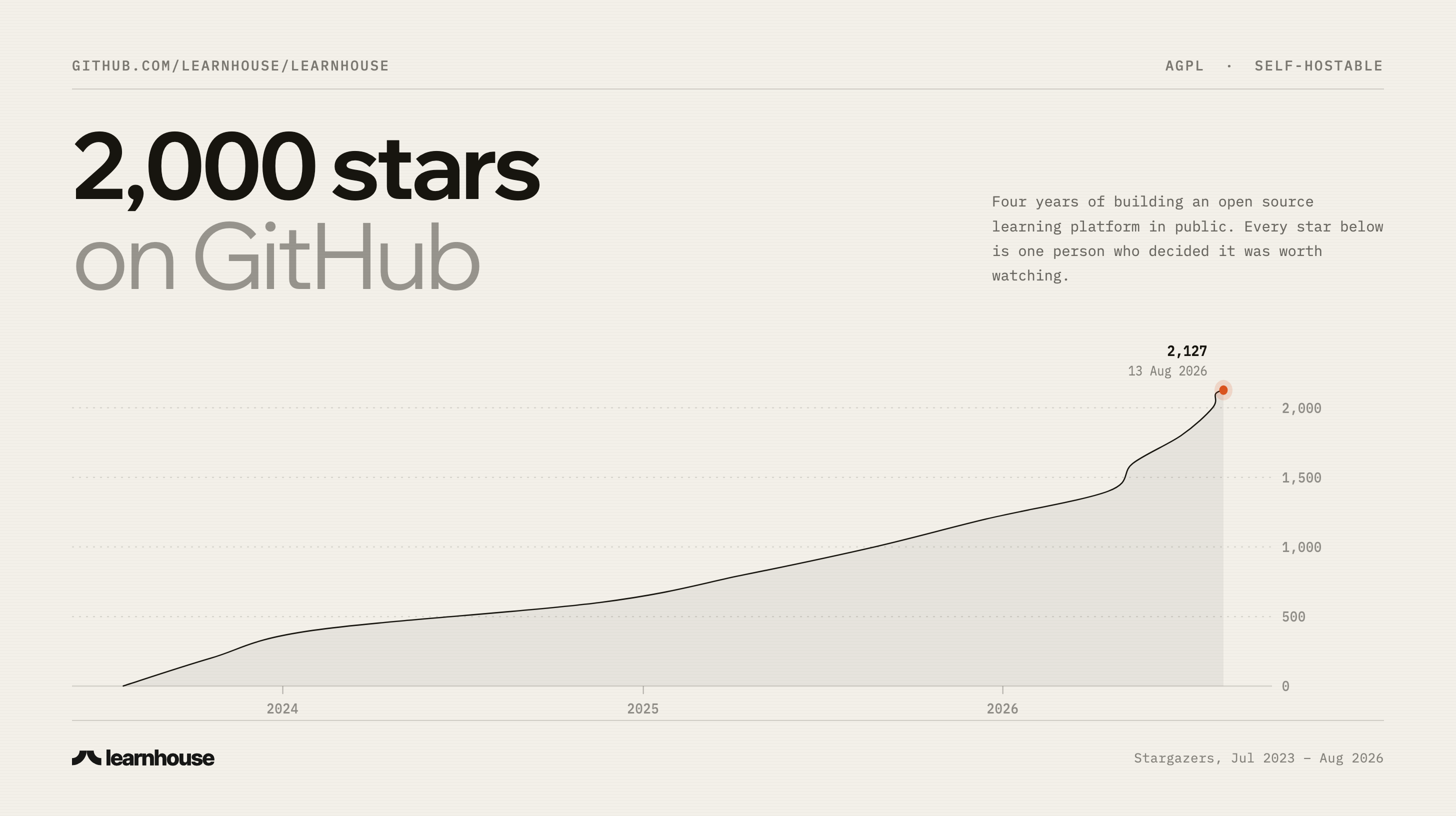
LearnHouse just passed 2,000 stars on GitHub.
I know a star is a small thing. One click, no commitment, nobody signs anything. But when you are building something mostly on your own, two thousand of those clicks add up to a very clear signal: people want an open learning platform that doesn't feel like it was frozen in 2012.
So, thank you. Genuinely.
Where this started
The first commit landed in May 2022. The idea was simple and slightly stubborn: teaching online shouldn't mean choosing between a closed platform that owns your audience and takes a cut, or an open source project that technically works but is painful to use every single day.
I wanted the third option. Open, modern, and good enough that you'd pick it even if it weren't free.
For a long time that meant a lot of quiet work. Rewrites, dead ends, features that got deleted a week after shipping. The repo sat at a few hundred stars for a while, and honestly that was fine, because the product wasn't ready to be loud about.
What changed
Somewhere in the last year the shape of it clicked. Courses, payments, communities, AI, podcasts, collaborative boards, code playgrounds, and analytics stopped being a list of things I wanted to build and started being a platform you could actually run a school on.
The summer update was the turning point. Folders, faster video with AI captions and translations, a proper integrated dashboard, and self-hosting that no longer required you to enjoy suffering. After that, the stars stopped trickling and started arriving.
Over 2,000 stars, more than 470 forks, and four years of building in public. Everything is still AGPL, still self-hostable, still yours.
What the stars actually bought
A star doesn't pay a server bill. What it does is much more useful than that.
It brings people in. Almost every contributor, translator, and self-hoster who has shown up found the project because it looked alive on GitHub. Momentum is the real currency of an open source project, and stars are how strangers decide whether to give you twenty minutes.
It keeps the roadmap honest. Issues get filed by people running LearnHouse in real classrooms and real businesses. That feedback is sharper than anything I'd come up with alone at 2am.
It makes the case for staying open. Every so often the sensible business move looks like closing something off. Two thousand people who starred a repo specifically because it was open is a good argument against that.
What's next
I'm not going to turn this into a roadmap post, so here is the short version of where my head is at:
Better onboarding. Getting from "I cloned this" to "my first course is live" should take minutes, whether you're self-hosting or using the cloud.
Deeper AI, less gimmick. The AI layer should do the boring work: captions, translations, assessments, study material. Not chat for the sake of chat.
More hands on the codebase. The next milestone I care about isn't 3,000 stars, it's more people comfortable enough with the code to open a pull request. If that's something you want to try, the issues tagged for newcomers are the place to start.
If you want in
The repo is at github.com/learnhouse/learnhouse. Star it if you haven't, fork it if you're curious, and file an issue if something annoys you. That last one helps the most.
And if you'd rather just use it without touching a terminal, the hosted version is right there.
Four years in, still building. Thanks for being here for it.